
Within the Epstein Files, There Should Have Been More Photos. What Happened to the Pictures?
How Three Million Hidden Files Still Shield the Powerful

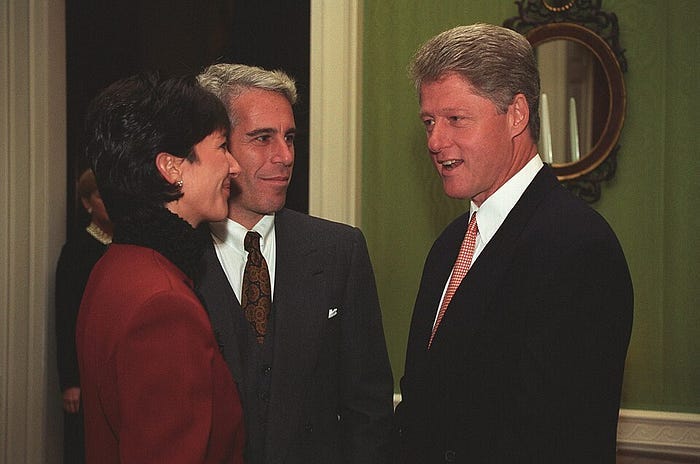
There are no doubt thousands of photos that were part of the Epstein files that the public has no right to see. The Department of Justice released many of them anyway, including nude photos of victims that have since been redacted. My question is: what happened to the photos of Epstein’s associates (men) that haven’t seen the light of day?
We’ve seen a photo of the late Virginia Giuffre with Prince Andrew. Bill Clinton, Bill Gates, Richard Branson. Woody Allen, Steve Bannon and many others have appeared in non-compromising positions. Yet many photos have never come out. I can think of no logical reason other than a desire to protect the men. Can you think of another?
Having your photo in the Epstein files isn’t proof of guilt. Then again, some photos may be more suggestive than others. Pictures taken at Epstein Island or the Zorro Ranch in New Mexico may require more explaining than a photo at a public event.
Commerce Secretary Howard Lutnick told several lies about his relationship with his next-door neighbor Epstein. After Epstein’s death, Lutnick bragged about how he and his wife decided they would have nothing to do with Epstein after one visit together to his home years earlier. One photo of Lutnick on Epstein Island proved he’d lied previously. That’s the kind of photo that could tell us a lot that we haven’t seen.
Virginia Giuffre gave depositions to the FBI in which she said Epstein took pictures of her with other men. Where are the pictures?
Victim Sarah Ransome has referenced photos taken on Little St. James (“the island”), photos taken during nude massage sessions. Nude photos of the girls should never be released. We may find out whether lawyer Alan Dershowitz kept on his tightie whities as he’s claimed. Ransome has said Epstein kept “hundreds” of images that were never disclosed.
Victim Maria Farmer has referenced missing photos taken at Les Wexner’s estate. There are photos taken during “art modeling sessions” that she says were seized by the FBI. None of these appear in the public releases.
Victim Annie Farmer has referenced photos taken during a New Mexico trip, including photos taken of her during the massage encounter with Maxwell.
Victim Johanna Sjoberg mentioned missing photos taken inside Maxwell’s Manhattan residence. She, too, claims there are photos of her with Prince Andrew. One photo of Prince Andrew is publicly available; the rest she described are missing.
Chauntae Davies has referenced photos taken on Epstein’s private jet. Photos taken on Epstein’s island. Photos taken of her with other girls on trips. Only a handful of flight‑related photos exist; the rest she described are missing.
Haley Robson has referenced photos taken inside Epstein’s Palm Beach home. “Jane Doe #43” (Palm Beach police report) referenced photos she saw on Epstein’s computer. “Jane Doe #2” (civil suit deposition) referenced photos taken of her in Maxwell’s dressing room. “Jane Doe #15” (FBI interview) described photos she saw printed and stored in Epstein’s office.
The public has now seen enough of the Epstein archive to understand one thing clearly: the wrong people were protected. The partial releases — tens of thousands of pages and a curated handful of photographs — exposed victims’ faces, victims’ names, victims’ bodies, and victims’ trauma long before they exposed the powerful men who moved freely through Epstein’s homes, planes, and island. The imbalance wasn’t accidental. It was structural.
Releasing the remaining three million files matters because the truth is still asymmetrical. Survivors have spent decades being asked to remember what was done to them. At the same time, the government sits on photographic evidence of who was present, who participated, and who enabled Epstein’s operation. Those images are not voyeuristic; they are evidentiary. They establish timelines. They confirm proximity. They show who was comfortable in Epstein’s spaces and who wasn’t merely a name in a deposition but a physical presence in the rooms where crimes occurred.
The photos of men — politicians, financiers, cabinet officials, and Epstein’s well‑connected neighbors — have been protected far more aggressively than the photos of the girls and young women they were photographed beside. That protection has consequences. Without the full archive, survivors are forced to carry the burden of proof alone, while the men who appear in unreleased images continue to deny, minimize, or rewrite their involvement. The public cannot evaluate those denials without access to the evidence.
The remaining files are not just historical records; they are accountability records. They show who Epstein trusted, who trusted him, and who believed his wealth and connections made them untouchable. Releasing them — fully, without redactions designed to shield reputations — would finally reverse the imbalance that has defined this case from the beginning. It would protect survivors instead of perpetrators. And it would allow the country to confront the truth with the same clarity survivors have been forced to live with for decades. Show me the pictures!
The voluminous documentation whether hard copy, electronic, photos, reels, bank records, public, private, etc is suppressed because holders have decided, pressure notwithstanding, that sham(e), profit, fear and/or the lack of morals inherent in the unspeakable harm done in the youth trafficking portion pales in comparison to the linked organised networking and conspiracies for the protection of high profile participants connecting their other far reaching offences and undertakings much of which are not necessarily crimes that have ended.
They're held by Vladimir Putin and Benjamin Netanyahu. I'm not sure who has them in America. It might be DOJ, CIA, FBI, or DHS. It might be Todd Blanche.