
Understanding Voting Rights Through South Carolina's 6th District
Jim Clyburn was the state's first Black Representative in 95 years

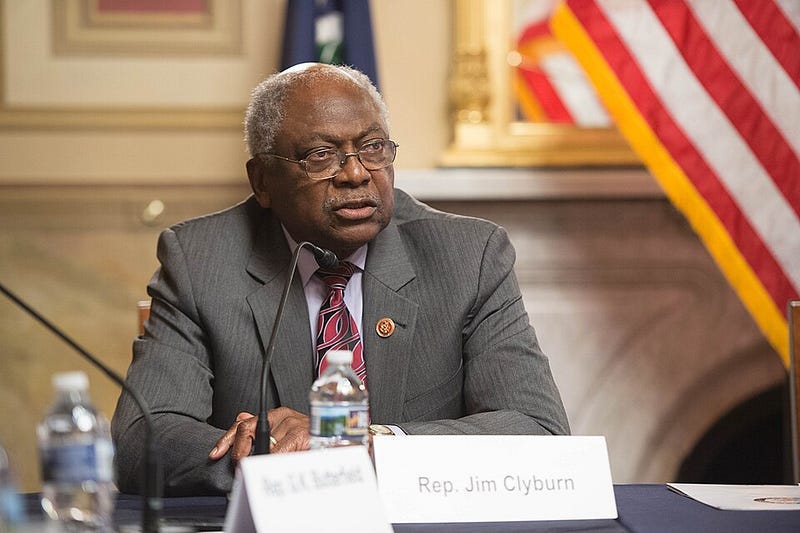
Understanding the impact of the Voting Rights Act of 1965 (VRA) and what we’re reverting to since it’s been gutted, chewed up, and spit out by the Supreme Court is hard to comprehend. Most of the time, voting rights are discussed in broad terms, and it doesn’t really sink in. I want to take a look at a single congressional district in South Carolina to illustrate the significance of the VRA and where things are demonstrably headed without it.
The 6th District was created in 1803. Under the Apportionment Act of 1788, South Carolina was allocated 6 seats in the very first House of Representatives. South Carolina had six seats because representation was based on its free population plus three‑fifths of the enslaved population. Slaves outnumbered white people in South Carolina. All six representatives were elected at‑large, statewide, rather than by district. This system massively benefited the planter elite, who could coordinate statewide slates and shut out dissenting voices.
South Carolina began electing its U.S. House members from districts in 1792–1793, after Congress passed the Apportionment Act of 1792. South Carolina did create six districts in 1792 — but they were not yet numbered, and the boundaries were repeatedly redrawn before the modern numbering system stabilized. The 6th District didn’t appear by name until 1803, when the state gained seats after the 1800 Census and adopted a numbered district system.
Here are all 26 representatives who have ever held the seat. South Carolina had no representative in Congress during secession and the period including and surrounding the Civil War.
1. Levi Casey (Democratic‑Republican), 1803–1807
A Revolutionary War veteran and militia general. Represented the early agrarian interests of the upcountry. Died in office in 1807.
2. Elias Earle (Democratic‑Republican), 1807–1811
A prominent iron manufacturer and land speculator. Advocated for internal improvements and frontier development.
3. John C. Calhoun (Democratic‑Republican), 1811–1817
Yes — that Calhoun. Served here before becoming Secretary of War, Vice President, Senator, and the nation’s most influential pro‑slavery theorist.
4. Eldred Simkins (Democratic‑Republican), 1818–1821
A lawyer and planter. Later served in the South Carolina Senate. Represented the rising planter class.
5. George McDuffie (Democratic‑Republican / Jacksonian), 1821–1834
A major Nullification figure and ally of Calhoun. Later became the Governor of South Carolina. Fierce defender of states’ rights and slavery.
6. Robert B. Rhett (Nullifier / Democrat), 1837–1849
One of the most extreme pro‑secession voices. Known as the “Father of Secession.” His politics foreshadowed the Civil War.
7. William F. Colcock (Democrat), 1849–1853
A pro‑slavery Democrat who later became Collector of the Port of Charleston. Represented the entrenched planter elite.
8. William Aiken Jr. (Democrat), 1853–1857
Former Governor of South Carolina. One of the wealthiest slaveholders in the state. Opposed immediate secession but defended slavery.
9. John McQueen (Democrat), 1857–1860
A strong secessionist who withdrew from Congress when South Carolina left the Union in 1860.
Civil War Interruption (1860–1868)
South Carolina had no representation in Congress during secession and the Civil War.
10. John D. Kennedy (Democrat), 1868–1871
Returned the district to white conservative control during early Reconstruction.
11. Solomon L. Hoge (Republican), 1871–1875
A Northern‑born Republican supported by Black voters. Part of the brief Reconstruction coalition that expanded Black political power.
12. Edmund W.M. Mackey (Republican), 1875–1877
A Reconstruction Republican backed by Black voters. His contested elections reflected the violent overthrow of Reconstruction.
13. George D. Tillman (Democrat), 1879–1883
Brother of “Pitchfork Ben” Tillman. Helped usher in the Redemption era that dismantled Black voting rights.
14. Samuel Dibble (Democrat), 1883–1891
A lawyer and Confederate veteran. Served during the tightening of Jim Crow.
15. Eli T. Stackhouse (Democrat), 1891–1892
Confederate veteran and Farmers’ Alliance leader. Died in office.
16. George W. Shell (Democrat), 1893–1895
A Tillmanite populist who supported agrarian reforms while upholding white supremacy.
17. John L. McLaurin (Democrat), 1895–1897
Later became a U.S. Senator. Known for feuding with Ben Tillman, including a fistfight on the Senate floor.
18. James Norton (Democrat), 1897–1903
Oversaw the district during the final consolidation of Jim Crow disenfranchisement.
District eliminated (1933–1939)
South Carolina lost seats after the 1930 Census due to the Great Migration. The 6th District was temporarily dissolved.
District re‑established (1939–Present)
19. Hampton P. Fulmer (Democrat), 1939–1944
A New Deal Democrat focused on agriculture. Died in office.
20. Willa L. Fulmer (Democrat), 1944–1945
One of the earliest women to serve in Congress. Filled her late husband’s seat.
21. John J. Riley (Democrat), 1945–1949; 1951–1962
A segregationist Democrat who opposed civil rights legislation. Served two non‑consecutive periods.
22. Hugo S. Sims Jr. (Democrat), 1949–1951
A brief post‑war representative. Lost re‑election to Riley.
23. Albert W. Watson (Democrat → Republican), 1963–1971
A segregationist who switched to the Republican Party after the Civil Rights Act. Early symbol of the Southern realignment.
24. John Jenrette (Democrat), 1975–1980
A young reform‑minded Democrat whose career ended in the Abscam bribery scandal.
25. Robin Tallon (Democrat), 1983–1993
A moderate Democrat representing the pre‑1992 version of the district before it was transformed into a majority‑Black seat.
Modern Majority‑Black District (1993–Present)
26. Jim Clyburn (Democrat), 1993–Present
The first representative of the modern Voting Rights Act–mandated majority‑Black 6th District. A major national figure: House Majority Whip, civil rights leader, and one of the most influential Black lawmakers in U.S. history.
Despite the State of South Carolina being majority Black for over 127 years of District 6’s existence. It never had a Black representative until Jim Clyburn was elected in 1992. He has served there ever since, advancing in Democratic Party leadership because of his seniority.
Clyburn didn’t win his first and subsequent elections because white South Carolinians had a change of heart. After the 1990 Census, South Carolina submitted a redistricting plan that cracked Black voters across multiple districts, preserved white incumbents, and avoided creating any majority‑Black district.
The U.S. Department of Justice, enforcing Section 5 of the Voting Rights Act, rejected the map. This was the first time since Reconstruction that the federal government forced South Carolina to create a district where Black voters could elect a candidate of their choice. This rejection infuriated many white legislators.
The fight inside the State House was explosive. White legislators accused the DOJ of “racial engineering.” Black legislators accused the state of “100 years of racial gerrymandering.” The debate lasted months and often devolved into shouting matches. Some white lawmakers walked out of committee meetings. Others threatened lawsuits before the map was even finalized.
While the conflict was mostly inside the legislature, there were public protests. Civil rights groups, NAACP chapters, and Black churches organized rallies demanding a majority‑Black district. Meetings in Columbia, Charleston, and Orangeburg drew crowds far beyond capacity.
Some white residents testified that a majority‑Black district would “destroy the state,” “divide the races,” or “hand power to extremists.” Black lawmakers and activists reported threatening phone calls, anonymous letters, warnings that creating a Black district would “bring trouble,” racist slurs shouted at public meetings, and death threats. These were not mass‑violence threats like the 1960s, but they were credible, targeted, and ugly.
Under pressure from the DOJ and federal courts, the legislature created South Carolina’s first majority‑Black congressional district since 1895.
It stitched together:
Columbia
Orangeburg
Sumter
The Black parts of Charleston
Rural Black Belt counties
White legislators called it “the I‑95 ghetto district.” Black leaders called it “the first fair district in a century.”
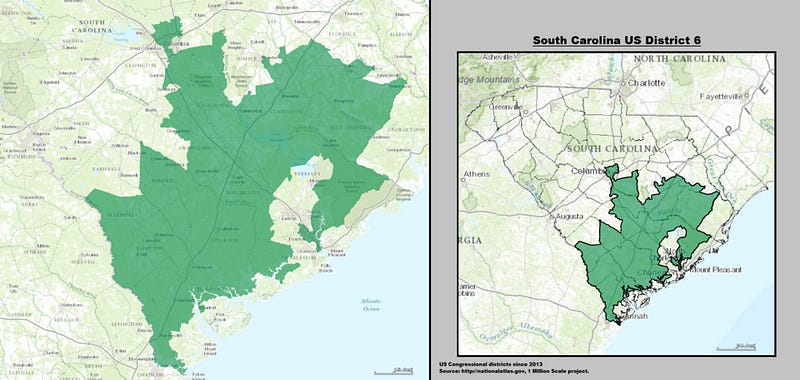
There was immediate whitelash after the district was created. There were multiple lawsuits claiming the district was an unconstitutional racial gerrymander. Jim Clyburn, then a state official, received hostile mail and warnings that he was “destroying the state.” Local radio hosts called the district “a racial carve‑out” and “federal tyranny.” Some white lawmakers vowed to dismantle the district “as soon as the courts allow it.” This hostility continued into the mid‑1990s.
Federal courts reviewed the district repeatedly. District 6 survived initial challenges. Later Supreme Court rulings forced minor boundary changes. But the core majority‑Black district remained intact. This is why Jim Clyburn has represented the district continuously since 1993.
South Carolina’s congressional map — especially District 1 and District 6 — has been tied up in litigation for years. Civil rights groups sued the state, arguing that the legislature unconstitutionally moved tens of thousands of Black voters out of District 1 and packed them into District 6, diluting Black voting power.
A three‑judge federal panel ruled that the map was an unconstitutional racial gerrymander. The U.S. Supreme Court took the case, putting the entire map — including District 6 — under review.
The Court’s ruling (2024) made two things clear. The Court did not force South Carolina to redraw the map immediately. But it left the door open for future challenges to the way Black voters are packed into District 6.
District 6 is not “safe” from redistricting — it is simply not being redrawn yet. The legislature could revisit the map after the next Census, or sooner if new lawsuits succeed.
South Carolina is in an active mid‑decade redistricting process for the 2026 elections. This process includes all seven congressional districts, including District 6.
The push was triggered by a May 14, 2026, special session called by Gov. Henry McMaster specifically for congressional redistricting. The path was cleared after the Supreme Court’s April 29 decision in Louisiana v. Callais, which created a wave of redistricting, affecting almost every Southern state. Because District 6 is the state’s only Democratic and only majority‑Black district, any statewide redraw inevitably affects it.
If you understand the history of South Carolina’s 6th District, you understand the South.
From its birth in 1803 as a planter‑era district, to its disappearance under Jim Crow, to its rebirth in 1992 only because the Voting Rights Act forced the state to stop suppressing Black voters, the 6th District has always been a mirror of the region’s deepest political instincts. Every line drawn, every boundary shifted, every lawsuit filed has reflected the same underlying struggle: who gets to wield power, and who is pushed to the margins.
Partisanship matters, of course. Republicans and Democrats fight over maps because maps decide seats. But in the South, partisanship is never the whole story. The modern 6th District exists because Black political power had to be restored after a century of deliberate erasure. And every attempt to shrink, dilute, or “rebalance” it today follows the same pattern that shaped the region after Reconstruction: when Black voters gain influence, the political system moves to contain it.
That is why the battles over District 6 feel familiar. They are not just about party advantage. They are about the long shadow of a racial order that has never fully disappeared — only adapted. The lines on the map change, but the logic behind them rarely does.
Understanding District 6 is understanding the South: a place where the fight over who counts, who is heard, and who is represented has never been abstract. It has always been about race first, and everything else second.
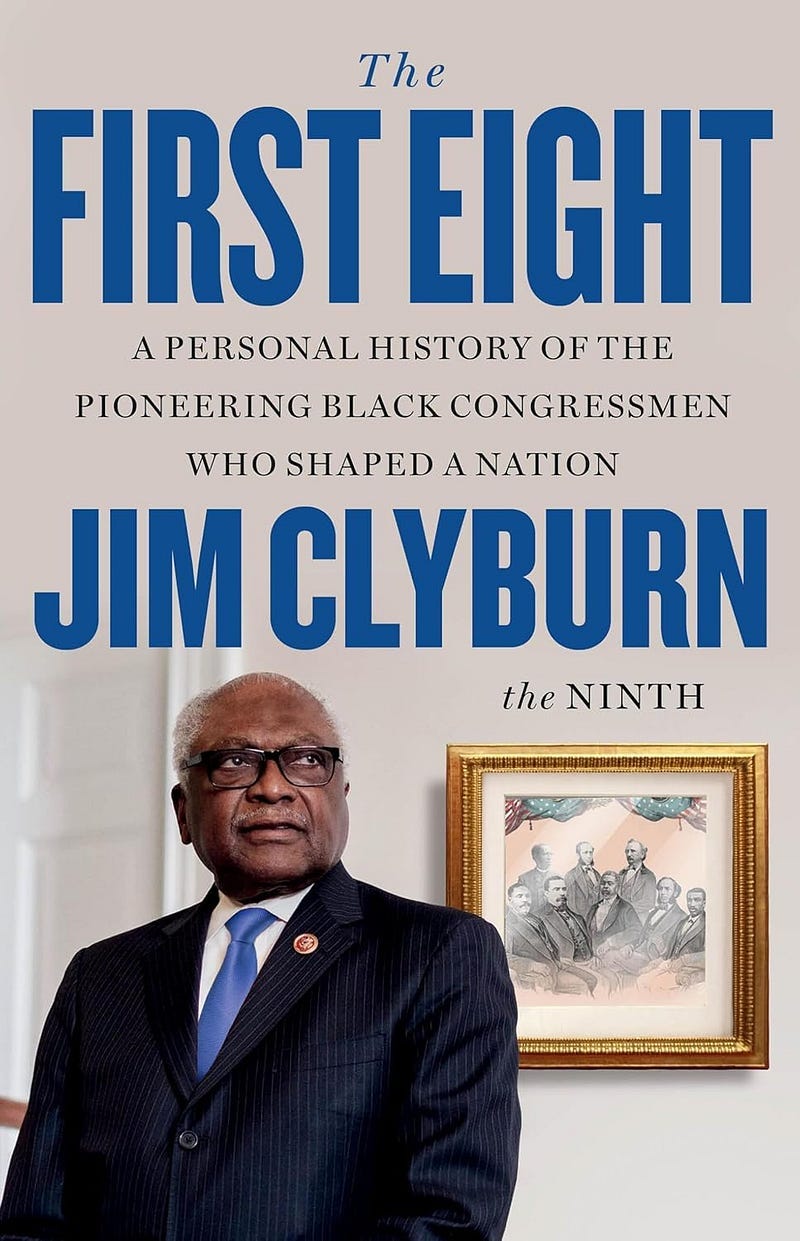
Jim Clyburn just released a book called The First Eight, which describes the untold story of the pioneering Black congressmen from South Carolina elected in the aftermath of the Civil War and reveals why it took nearly a century before the ninth, James Clyburn, was elected. Clyburn has mentioned retirement several times recently, but has not announced a date. Will it be another 95 years before South Carolina has a Black Representative?
I saw Clyburn promoting his book the other day and paid it no attention. Everybody has a book, right? Having now done a little research. I'm ordering it now!
Excellent post. Thanks for the storyline and contextual framework. 95 years in a blink on an eye. Not a day in vain. I just bought the Congressman’s book. Haven’t read it ! Nothing like the vantage point of the person who was there.