

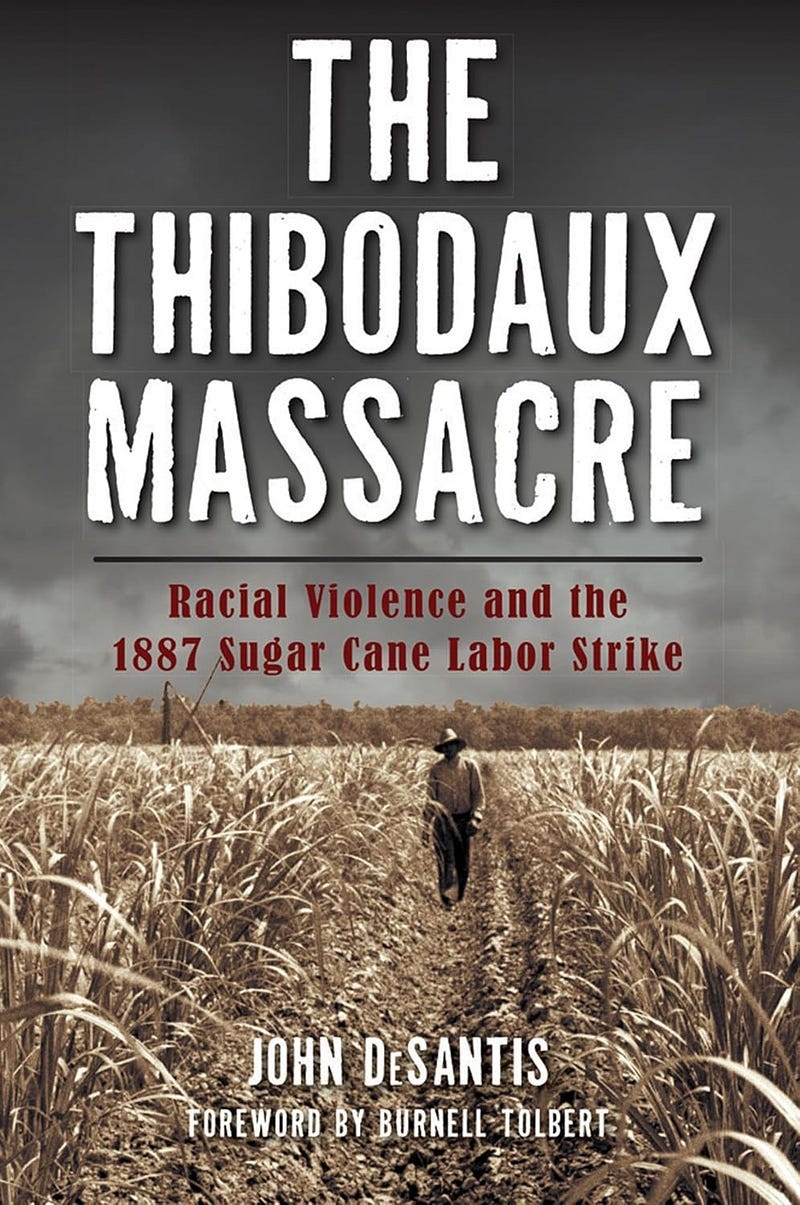
I. Prologue: Sugar Country
In the fall of 1887, the sugar fields of Lafourche Parish stretched for miles in every direction. Flat, humid land was carved into plantations that had changed names but not practices since the Civil War. The men and women who cut cane in those fields were overwhelmingly Black, many of them formerly enslaved on the same land. Their labor powered the sugar mills, the rail lines, and the fortunes of the white planters who dominated southern Louisiana politics.
By October, the cane was tall and ready for harvest. The air smelled of molasses and smoke. But beneath the surface, something else was brewing: anger, exhaustion, and a demand for dignity that had been denied for generations.
This is the story of the Thibodaux Massacre, one of the deadliest labor massacres in American history, and one of the least taught. It is a story of Black workers who dared to strike, white planters who refused to yield, and a town that became the stage for a brutal act of racial violence. It is also a story of silence, and how the massacre was buried, how descendants were never told, and how the land itself held the memory until people were ready to listen.
II. What Led Up to the Massacre
A. Reconstruction’s Collapse
By 1887, Reconstruction was dead. Federal troops had withdrawn, white supremacist paramilitary groups had seized political control, and Black Louisianans were living under a regime that looked disturbingly like the one they had survived before emancipation. Sharecropping and plantation labor replaced slavery with new chains: debt peonage, exploitative contracts, and violence used to enforce obedience.
Sugar plantations were among the harshest employers in the South. The work was seasonal, dangerous, and poorly paid. Workers were often paid in scrip; tokens redeemable only at plantation stores, where prices were inflated. Wages were withheld until the end of the harvest, ensuring workers could not leave. Black laborers were trapped.
B. The Knights of Labor Arrive
In the mid‑1880s, the Knights of Labor, one of the largest labor organizations in the country, began organizing sugar workers in Louisiana. Unlike many unions of the era, the Knights accepted Black members. Their message was simple: workers deserved fair wages, cash payments, and humane working conditions. By 1886, thousands of Black sugar workers had joined.
The planters saw this as an existential threat. If Black workers organized, the entire plantation economy could collapse. White elites responded with intimidation, firings, and threats of violence. But the workers held firm.
C. The 1887 Sugar Strike
In October 1887, the Knights of Labor called a strike across the sugar parishes. Tens of thousands of Black workers walked off the job, demanding:
$1.25 per day in cash
Biweekly payment
The right to choose where they shopped
An end to forced plantation stores
The strike was massive. Mills shut down. Cane rotted in the fields. Planters panicked.
Governor Samuel McEnery, himself a sugar planter, deployed the state militia to break the strike. Armed white paramilitary groups joined them. Violence erupted across the parishes. Workers were beaten, arrested, and driven from plantations at gunpoint. But in Thibodaux, the strike held.
III. The Road to Thibodaux
A. A Town on Edge
Thibodaux was a small town, but strategically important. It was a hub for sugar transport and a center of white political power. As the strike intensified, hundreds of Black workers sought refuge in the town, believing it safer than the plantations. White residents saw this as an invasion.
Rumors spread that Black workers were planning an uprising. Newspapers inflamed tensions, portraying strikers as dangerous radicals. Planters demanded action. The mayor of Thibodaux, E. A. Burke, declared martial law and formed a white “peacekeeping” militia, a euphemism for an armed vigilante force.
B. The Ultimatum
On November 1, 1887, the mayor issued an order:
All Black workers must leave Thibodaux by sunrise.
The workers refused. They had nowhere to go. Many feared they would be killed if they returned to the plantations.
IV. The Massacre
A. November 23, 1887
At dawn on November 23, the white militia surrounded the Black neighborhood known as “Back of Town.” The streets were quiet. Families were inside their homes. Some were preparing breakfast. Others were still asleep. Then the shooting began.
White militiamen opened fire on anyone they saw. They moved house to house, dragging people outside, shooting them in the street, or killing them where they stood. Witnesses later described bodies lying in doorways, in yards, and along the road.
Black workers who tried to flee were hunted down. Some were shot in the cane fields. Others were executed after surrendering. The massacre lasted hours.
B. The Numbers
The official death toll was reported as 30. Historians believe the real number was between 50 and 300. Many victims were buried in unmarked graves. Some were dumped in mass burial pits. Others were left where they fell until family members could retrieve them under cover of night. No white militiaman was ever charged.
C. The Aftermath in Town
By midday, Thibodaux was silent. The Black neighborhood was shattered. Survivors hid in the woods, fled to nearby parishes, or left Louisiana entirely. The strike was broken.
The Knights of Labor were crushed in the sugar parishes. Black workers returned to the plantations under even harsher conditions. Wages were lowered. Surveillance increased. Organizing was banned. The message was clear: resistance would be met with death.
V. The Aftermath: Silence and Survival
A. The Official Story
Local newspapers celebrated the massacre as a victory for “law and order.” White officials claimed the militia acted in self‑defense. The governor praised the town for restoring peace. The truth was buried.
For generations, white residents refused to speak of the massacre. Black families whispered about it but rarely shared details. Trauma, fear, and the threat of retaliation kept the story underground.
B. Descendants Without History
Many descendants of the victims grew up never knowing what happened. Some heard fragments, “your great‑grandfather was killed in the strike,” or “they shot him in Thibodaux,” but the full story was withheld. Others learned nothing at all. The massacre became one of the many erased chapters of Black history in the South, hidden by design.
C. Rediscovery
In the early 2000s, historians began piecing together the story through:
oral histories
church records
Knights of Labor documents
newspaper archives
plantation ledgers
Archaeologists identified possible mass grave sites. Community members began holding memorials. Descendants started asking questions. The silence cracked.
D. Why It Matters Today
The Thibodaux Massacre is not just a story of violence. It is a story of:
Black labor organizing
white supremacist backlash
economic exploitation
political power
historical erasure
It reveals how deeply intertwined race and labor were, and still are, in America. It shows how violence was used to maintain economic systems built on Black labor. And it reminds us that many of the freedoms workers enjoy today were won through struggle, sacrifice, and, in Thibodaux’s case, bloodshed.
VI. A Story Still Unfolding
Today, descendants of the victims walk the same streets where their ancestors were killed. They attend churches built by survivors. They live on land that once held unmarked graves. Some are only now learning the truth and discovering that their family history includes one of the largest labor massacres in American history.
The town of Thibodaux has begun acknowledging the past. Historical markers had long been proposed and were finally installed and unveiled in June 2025, ending more than a century of official silence. Community groups hold remembrance events. Scholars continue researching burial sites. But the work is not finished.
The massacre’s legacy lives on in the economic inequalities of southern Louisiana, in the racial divides that persist, and in the ongoing struggle for labor rights across the country. To tell the story of Thibodaux is to confront the reality that America’s labor history is also America’s racial history, and that both are marked by violence, resistance, and the fight for dignity.
VII. Epilogue: The Land Remembers
If you walk through Thibodaux today, the sugar fields still stretch toward the horizon. The mills still hum. The air still smells of cane and smoke. But beneath the soil lies a history that refuses to stay buried. The land remembers, and so do we.
Corporations are controlling minorities today, many who are not white nor speak English. They are uneducated and unaware of their constitutional rights. They work 6-7 days of two part time jobs to survive. The economic inflation is another weapon. Wages are inhumane at $4/hour farm wage and $7.25 other. We know in today’s economy that $30/hour equals minimum wage of the pre-Regan era of purchasing power. USA has substandard living conditions for half of the workforce. Wages have not increased in decades.
This horrific story needs to be mainstreamed. Can someone please write a movie script?