
The Second Amendment: The Founder’s Intent and What Rights Were Never Intended
Uncovering the Real Fears Behind the Second Amendment — and the Rights It Never Promised

The Constitution of the United States was drafted during the Philadelphia Convention of 1787, from May 25 to September 17, 1787. It was then sent to the states for ratification, a process that lasted until June 21, 1788, when New Hampshire became the ninth state to approve it, making the Constitution operative. The new federal government officially began on March 4, 1789.
The Bill of Rights was not part of the original Constitution. It was added because ratification nearly failed in states such as Virginia, New York, and Massachusetts due to fears that the new federal government would be too powerful.
The three major reasons the Bill of Rights became necessary
1. Anti‑Federalist pressure
Anti‑Federalists argued that the Constitution lacked explicit protections for:
free speech
freedom of religion
jury trials
limits on federal power
state control over militias
They feared the new government could become another distant, unaccountable authority like Parliament. Patrick Henry, George Mason, and others insisted that no Constitution should be adopted without a bill of rights.
2. Ratification deals
Several states ratified the Constitution only on the condition that amendments would be added immediately. Massachusetts, for example, approved the Constitution with recommended amendments attached, a political compromise known as the “Massachusetts Compromise.” Without this promise, ratification would likely have failed.
3. Madison’s political pivot
James Madison originally believed a bill of rights was unnecessary; he thought the Constitution already limited federal power. But once he saw how close ratification came to collapsing, he reversed course. In 1789, Madison introduced a set of amendments in the First Congress to fulfill the promise made to the states. Twelve amendments were sent to the states; ten were ratified by December 15, 1791, becoming the Bill of Rights.
The language of the Second Amendment, like the Constitution itself, was a compromise to secure all the states’ agreement to the Constitution. The writer, Madison, originally included an arms clause in a broader Amendment that also included rights to free speech, freedom of the press, religion, and assembly, along with due process and no double jeopardy. The right to bear arms was set forth as a standalone Amendment, highlighting how important it was to some of the Founders.
The original draft, submitted to the House of Representatives, included a clause for conscientious objectors. who for religious reasons couldn’t be compelled to carry arms. There was a clause preventing standing armies from disarming the people. Madison’s draft was meant to reassure Anti‑Federalists — especially in Virginia — that the new federal government could not destroy state militias (which, in the South, meant slave patrols). Here is James Madison’s original draft:
“The right of the people to keep and bear arms shall not be infringed; a well armed and well regulated militia being the best security of a free country: but no person religiously scrupulous of bearing arms shall be compelled to render military service in person.” — James Madison
The Senate Version included the following changes to the House version:
Removed “body of the people”
Removed conscientious‑objector protections
Removed standing‑army limitations
Removed explicit militia‑service linkage
Condensed into a single sentence
The Senate version is what was ratified in 1791 and is what we now know as the Second Amendment:
“A well regulated Militia, being necessary to the security of a free State, the right of the people to keep and bear Arms, shall not be infringed.” — Second Amendment
One of the main arguments on behalf of preserving the “well-regulated militias” was the need to preserve slave patrols in the South. Patrick Henry, a Virginia plantation owner, made the argument often in the Virginia Ratifying Convention (1788):
Congress might “neglect or refuse” to arm the militia, on which the South relied for slave control. — Patrick Henry
Disarming the militia would end the South’s security system — Patrick Henry
“The Constitution enabled Congress to subvert the slave system by disarming the militia, a terrifying prospect because the South lived in constant fear of slave insurrection.” — Patrick Henry
George Mason, another Virginia plantation owner, made clear his concerns:
“The militia may be here destroyed by that method which has been practiced in other parts of the world before; that is, by rendering them useless — by disarming them.” — George Mason
South Carolina’s delegates at the Constitutional Convention (Charles Pinckney, Charles Cotesworth Pinckney, John Rutledge, Pierce Butler) all spoke extensively about protecting slavery. Their concerns were expressed through:
The Three‑Fifths Clause
The Fugitive Slave Clause
The ban on banning the slave trade until 1808
Whatever you believe about the Founders’ intent to bestow individual rights to possess guns, as declared in District of Columbia v. Heller in 2008. They absolutely intended to protect slave patrols, and without such protections, we would not have had a Constitution or a Union.
If you’re wondering why Southern states were willing to go to the mattresses to defend slave patrols. Southern plantation owners believed their families’ lives depended on them for survival.
At Thomas Jefferson’s Monticello (Albemarle County, Virginia). The enslaved population was approximately 130 at peak (around 1817–1820), while white residents (Jefferson, family members, overseers, and hired white workers) were normally 10–12. Enslaved people outnumbered whites by roughly 10 to 1.
James Madison — Montpelier (Orange County, Virginia) grew up on a plantation with the largest enslaved population in Orange County. Enslaved people numbered 100 at peak. White residents were typically 8–10 (Madison, Dolley, family, overseers). Enslaved people outnumbered whites by roughly 10 to 1.
Patrick Henry owned enslaved people throughout his life, but his plantations were smaller than those of Jefferson or Madison. His enslaved people were typically 30–40 at peak. The white residents were usually 6–10 (Henry, family, overseers). Enslaved people outnumbered whites by roughly 4 to 1.
The entire state of South Carolina had more enslaved people than whites until 1930. In addition to capturing runaway slaves, slave patrols, those well-regulated militias, were responsible for protecting the white people on the plantations. By the time the Constitution was ratified, dozens of major slave revolts had taken place in America and other countries along the International slave trade route. To Southerners, the struggle to maintain slave patrols was real.
The firearms available in America when the Second Amendment was written (1787–1791) were overwhelmingly flintlock, single‑shot, black‑powder weapons. No revolvers, no repeaters, no cartridge ammunition, no rapid fire. Nowhere in the 27 words of the Second Amendment does it contemplate AR-15-style weapons, high-capacity magazines, and semi-automatic handguns and shotguns, which are now considered legal under the Second Amendment in most states. Fully automatic machine guns and “military-grade weapons” are still mostly illegal. How long before the NRA-approved judges running the federal courts make those fully legal as well?
The Founders would be surprised at the right to carry guns in public.
New York State Rifle & Pistol Association v. Bruen (2022) held that the Second Amendment protects carrying firearms outside the home in “places of confrontation.” Many early American cities had strict public‑carry restrictions. The Founders expected regulated militia musters, not widespread public carry. Bruen created a new “text, history, and tradition” test that did not exist at the Founding.
Restraining orders did not exist in 1791. The Founders would be amazed to learn their Amendment allowed dangerous persons to remain armed. For years, courts struck down laws disarming people with domestic‑violence restraining orders. In United States v. Rahimi (2024), the Court finally upheld a federal law disarming individuals subject to domestic‑violence restraining orders, but only after years of lower‑court rulings striking down such laws.
When we strip away the mythology that has grown around the Second Amendment, we’re left with a simple truth: the Founders were not talking about an unregulated, unlimited personal right to own any weapon imaginable. They were talking about militias — real, state‑controlled institutions that served specific political purposes, including, in the South, the enforcement of slave patrols. Madison wrote the Amendment to calm fears voiced by men like Patrick Henry and George Mason, who worried that the new federal government might disarm the very forces they relied on to maintain social order.
Nothing in the debates of 1787–1791 suggests the Founders believed the right to bear arms was absolute. In fact, the historical record shows the opposite. Early American governments regulated gunpowder storage, prohibited firing weapons in cities, restricted public carry in populated areas, and imposed mandatory inspections on militia firearms. The Founders lived in a world where every gun was a single‑shot flintlock, where “arms” meant slow, fragile tools that required training and discipline — not weapons capable of firing dozens of rounds in seconds.
If confronted with today’s argument that “no weapon can be regulated,” the Founders would not recognize it as their own. They believed in regulation as a condition of liberty, not a threat to it. They expected weapons to be controlled, inspected, and governed by the states. They expected militias to be supervised. They expected public safety to matter. And they expected future generations to legislate as technology evolved — because they themselves legislated constantly.
The modern claim that the Second Amendment forbids all regulation is not originalism. It is amnesia. It forgets the world the Founders lived in, the fears that shaped their choices, and the limits they assumed were obvious. The Founders did not write a suicide pact. They wrote a compromise — one meant to preserve state authority, prevent federal overreach, and maintain a militia system that no longer exists.
What they left us is not a command to accept every weapon without question. They left us a responsibility: to regulate arms in ways that protect the public, just as they did and just as they expected future Americans to continue to do. The Second Amendment was never meant to freeze us in 1791. It was meant to give us the tools to govern ourselves — and the courage to adapt when the world changes.
Across American history, lawmakers repeatedly passed statutes designed to keep guns out of the hands of specific groups, and the pattern is unmistakable: regulation was not only common, but it was also targeted. In the colonial and Founding eras, nearly every Southern colony enacted laws prohibiting enslaved people from possessing firearms, even when supervised, and required white patrols to search Black homes for weapons.
After the Revolution, states expanded these restrictions to include free Black people, imposing licensing requirements or outright bans that did not apply to whites. In the early 19th century, several states — most notably Tennessee and North Carolina, passed laws barring Native Americans from owning or carrying guns without permission from white authorities. By the mid‑1800s, cities such as New Orleans, Charleston, and Richmond enforced racialized gun‑control ordinances that limited public carry for Black residents while allowing whites to remain armed.
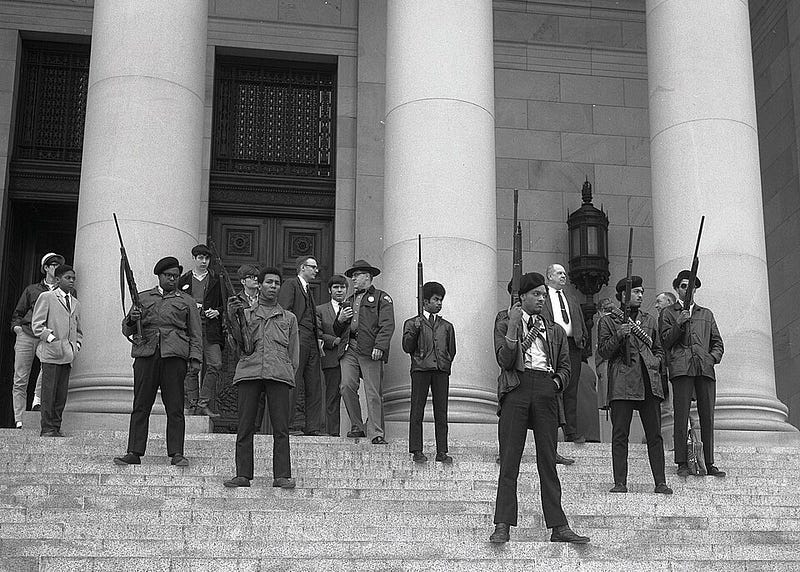
After the Civil War, Black Codes in states like Mississippi and Alabama attempted to continue disarming freedmen, prompting Congress to intervene through the Civil Rights Act of 1866 and the Fourteenth Amendment. Even in the 20th century, gun laws were used to target groups seen as threatening: California’s 1967 Mulford Act was passed specifically to disarm the Black Panthers, and earlier municipal laws restricted immigrants — especially Chinese and Italian laborers — from carrying weapons. Taken together, these laws show that America has a long tradition of regulating firearms, and that many of those regulations were explicitly aimed at controlling marginalized communities rather than preventing crime in a neutral way.
“The Leading White Men of Edgefield” | by William Spivey | The Polis | Medium
“The leading white men of Edgefield decided to seize the first opportunity that the Negroes might offer them to provoke a riot and teach the Negroes a lesson by having the whites demonstrate their superiority by killing as many of them as was justifiable.” — Benjamin Tillman
When a Black “well-regulated militia was formed, it resulted in the Hamburg massacre, where white militias and the National Guard borrowed a cannon from Georgia to wipe them out. The Second Amendment has never been race-neutral, and there’s no reason to suspect it will be.
Everybody knows of idiots who should not even have a plastic fork, much less a firearm- except machine gun Alito and Uncle Clarence. DD
I absolutely agree with you. The “originalism employed by the Scalia progeny is so vague it allows judges to cherrypick obscure sources to fit the desired outcome. It is intellectually dishonest.