

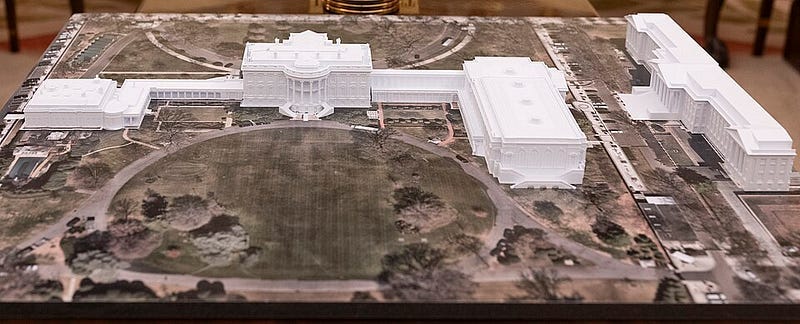
When the Supreme Court refused to block the continued construction of Donald Trump’s ballroom. They said the group that brought the lawsuit, the National Trust for Historic Preservation, wasn’t the right party to bring the matter before the court. They lacked “standing.” SCOTUS refused to address the issue even though Supreme Court Chief Justice John Roberts wrote in his dissenting opinion that the construction of the ballroom was “likely unlawful. The Supreme Court knowingly allowed Donald Trump to break the law using “standing” as the excuse.
Standing isn’t found in the Constitution. I know this because the Supreme Court said so in United States v. Texas (2023). Texas and Louisiana sued the Biden administration over DHS arrest‑priority guidelines. The Supreme Court dismissed the suit for lack of Article III standing — and in doing so, made the point unmistakably:
Article III requires only a “case or controversy.”
The Constitution does not define standing.
Standing is a judicially developed requirement rooted in separation‑of‑powers concerns, not in constitutional text.
The opinion cites earlier cases (Linda R.S. v. Richard D., Raines v. Byrd) to reinforce that standing is a court‑created threshold, not a constitutional phrase. The Court used this case to reaffirm that standing is a judicial tool for limiting federal courts to disputes “traditionally thought to be capable of resolution through the judicial process.”
Standing, as a formal judicial principle, is surprisingly new in American law. The Framers did not use the term, early courts did not articulate it, and the modern test is a 20th‑century invention, not a constitutional original. The originalists on the Court turned their backs on what the Framers intended when they allowed Trump his ballroom. Indeed, you don’t want a court system where uninvolved parties are suing everyone. It’s also true that when the nation sees the President breaking the law, any citizen ought to be allowed to oppose them.
The first time “standing” appears as a recognizable principle
The earliest seeds show up in Hayburn’s Case (1792) — but only as procedural confusion, not a doctrine. The Washington University Law Review notes that early courts did not use the word “standing,” nor did they articulate anything like “injury in fact,” “traceability,” or “redressability.”
The first actual standing rule: 1930s
The Constitution Annotated explains that before the 1970s, courts required a plaintiff to show injury to a legal right — meaning a right recognized at common law or statute. This appears clearly in:
Ala. Power Co. v. Ickes (1938)
Tennessee Electric Power Co. v. TVA (1939)
Both cases show the Court using a proto‑standing test: you must show a legal injury, not just a grievance.
This is allegedly the first consistent use of standing as a judicial gatekeeping principle. But standing had long been a principle in American courtrooms.
Standing was racially restricted long before the Supreme Court invented the doctrine.
1. Enslaved people had no legal personhood
Under slave codes, an enslaved person could not:
sue
be sued
testify against a white person
enter a contract
claim injury
claim rights
They were legally classified as property, which meant they had no standing in any court by definition. Standing wasn’t denied — it was impossible.
2. Free Black people were denied standing in most states
Even free Black Americans were barred from:
suing white people
testifying against white people
serving on juries
bringing claims involving property disputes with whites
challenging violence or fraud committed by whites
This was true in:
Virginia
North Carolina
South Carolina
Georgia
Florida
Mississippi
Louisiana
Texas
Alabama
Arkansas
Missouri
Kentucky
Tennessee
Many northern states also restricted Black testimony or civil claims well into the 19th century.
3. Dred Scott (1857) made the principle national
Chief Justice Roger Taney wrote that Black people — enslaved or free — were:
“not intended to be included under the word ‘citizens’ in the Constitution.”
And therefore:
had no standing to sue in federal court.
This is the most explicit articulation of racial denial of standing in American history.
4. Black testimony against whites was illegal in most states
Slave codes and Black codes made it a crime or nullity for a Black person to testify against a white person. If you cannot testify, you cannot prove injury. If you cannot prove injury, you cannot have standing. The original American standing doctrine — racial exclusion.
5. Jury service was racially barred
If you cannot sit on a jury, you cannot participate in adjudicating rights. If you cannot adjudicate rights, you cannot enforce them. Standing collapses.
America denied standing to Native Americans, Chinese immigrants, and others.
1. Native Americans
Native Americans were treated as non‑persons in U.S. courts for most of the nation’s history.
They could not:
sue white people
testify against white people
serve on juries
bring claims in federal court
assert constitutional rights
Why?
Because the law treated tribes as:
“domestic dependent nations”
“wards of the state”
outside citizenship
outside the judicial system
Until 1924, Native Americans were not U.S. citizens. Until 1968, many states still barred Native testimony against whites. Until 1978, Native parents had no standing to stop states from seizing Native children.
Standing was structurally impossible.
2. Chinese immigrants
Chinese immigrants were denied standing through a combination of:
racial testimony bans
citizenship restrictions
exclusion laws
court rulings that declared them “aliens ineligible for citizenship”
Concrete examples:
In California, Chinese people could not testify against whites (People v. Hall, 1854).
Without testimony, they could not prove injury.
Without injury, they had no standing.
Chinese immigrants could not naturalize, which meant they could not assert constitutional rights in federal court.
The legal system was designed to ensure white defendants could not be held accountable when the victim was Chinese.
3. Other immigrants (Mexican, Japanese, South Asian, Middle Eastern)
Across the 19th and early 20th centuries, many immigrant groups were denied:
the right to sue whites
the right to testify
the right to serve on juries
the right to bring federal claims
the right to naturalize (and therefore the right to assert constitutional protections)
If you cannot testify, you cannot prove injury. If you cannot prove injury, you cannot have standing. If you cannot have standing, you cannot access the law. This was the original American standing doctrine, racial exclusion disguised as procedure.
The Supreme Court has decided dozens of cases in the last two decades where standing was a major issue. For twenty years, the Supreme Court has used standing as a velvet rope — letting in states when it wants to reshape federal power, shutting out voters when elections get messy, and tightening the definition of injury until whole categories of Americans fall outside the frame. In most of these cases, the Framers would have been happy, because the court was living up to one of its original purposes, protecting the interests of the land-owning men who hold power. Looking at SCOTUS in general. Roger B. Taney would be proud of what he sees today.
Congress would have standing but they have no guts
None of the merits were discussed.