
Stonewall Jackson and Robert E. Lee Were Not Opposed to Slavery; They Fought to Preserve It
Why Students Shouldn’t Have to Learn Under the Names of Men Who Fought to Keep Them Enslaved

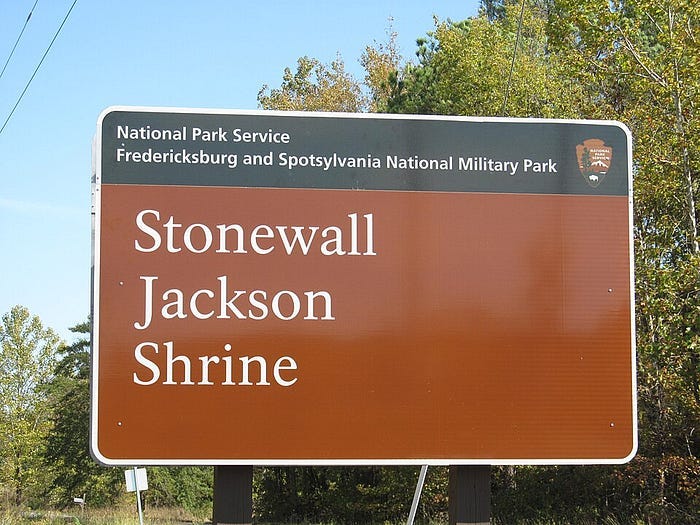
I recently wrote an article about two Virginia schools, one named after Confederate general Stonewall Jackson, that must change their names following a federal judge’s order. In an article I used for research, the top comment stated that both Stonewall Jackson and Robert E. Lee, after whom the other school was partially named, were opposed to slavery.
“Stonewall Jackson was against slavery and was known before the war for blatantly violating State Law by educating both slave and free black men. Robert E. Lee was also opposed to slavery. I see no racial problem at all with having their names on high schools in Virginia.”
I started to write, “no offense,” but that wouldn’t be true. I am offended. That is the stupidest shit I ever heard, and I have to take the time to rebut it, as several people went right along with this comment. Let’s start with Stonewall Jackson:
Stonewall Jackson
Jackson, along with dozens of others credited with being opposed to slavery, actually owned enslaved people. He purchased or leased three and acquired four more as part of his marriage dowry resulting from his marriage to Anna Morrison Jackson. Jackson also rented slave laborers as needed. He never released his slaves, keeping them until he died in 1863. His slaves were freed at the end of the Civil War in 1865 as part of the general emancipation.
Stonewall is credited with being against slavery because he taught a Sunday School class to enslaved people while a VMI professor at the Lexington Presbyterian Church. The church was founded, built, and operated as a white Presbyterian church in Lexington, Virginia. Its history, architecture, membership, and leadership were all white. Black people, free or enslaved, were not allowed to attend services, but could attend Jackson’s class, which was intended to reinforce slavery, not end it.
The pro-slavery theology of Presbyterians taught that enslaved people were spiritually incapable without white supervision. Religious instruction was meant to reinforce slavery, not challenge it. Slaveholders often viewed teaching religion as a paternal duty, not an act of liberation. Jackson’s Sunday School fit seamlessly into a proslavery theology… not to undermine slavery, but to bolster the institution.
Jackson taught a Sunday School for enslaved people from 1855–1861. It was unusual, technically illegal because he taught students to read scriptures that reinforced submission. It was fully consistent with pro‑slavery Christian paternalism. Modern claims that it proves Jackson was anti‑slavery are historically false.
Jackson didn’t make a lot of statements about the institution of slavery, but one he made before the war sums it up:
“In this county there is a strong Union feeling, and the union party have unanimously nominated Samuel McDowell Moore and Jas. B. Dorman as delegates to the convention, and I expect that a large majority will elect them. I am in favor of making a thorough trial for peace, and if we fail in this, and the state is invaded, to defend it with a terrific resistance… I desire to see the state use every influence she possesses in order to procure an honorable adjustment of our troubles, but if after having done so the free states, instead of permitting us to enjoy the rights guaranteed to us by the Constitution of our country, should endeavor to subjugate us, and thus excite our slaves to servile insurrection in which our families will be murdered without quarter or mercy, it becomes us to wage such a war as will bring hostilities to a speedy close. People who are anxious to bring on war don’t know what they are bargaining for — they don’t see all the horrors that must accompany such an event. For myself I have never as yet been induced to believe that Virginia will even have to leave the Union. I feel pretty well satisfied that the Northern people love the Union more than they do their peculiar notions of slavery, and that they will prove it to us when satisfied that we are in earnest about leaving the Confederacy unless they do us justice.”
Robert E. Lee
Lee acquired enslaved people at several points:
1829 — Inheritance from his mother. When Ann Carter Lee died in 1829, her will left “the remainder of my estate” to her sons. This likely included about 10 enslaved people inherited by Robert E. Lee at the age of 22.
1831 — Marriage into the Custis family. When Lee married Mary Anna Randolph Custis, he entered a household with over 100 enslaved people owned by her father, George Washington Parke Custis. These enslaved people were not Lee’s property, but he managed them.
1830s–1850s — Additional enslaved individuals he owned directly. Lee’s letters reference enslaved people he personally owned.
Lee owned 10–15 enslaved people during his lifetime.
Lee’s timeline for giving up enslaved people is more complex:
1846 — Lee’s will: His will stated that Nancy Ruffin and her children should be freed upon his death “when it can be done to their advantage.” They disappear from the record afterward.
1857–1862 — Custis estate emancipation. When Custis died in 1857, Lee became executor and was legally required to free nearly 200 enslaved people within five years. He took the full five years, freeing them in 1862.
Directly owned enslaved people: The National Park Service notes that there are no records of Lee formally freeing or selling the enslaved people he personally owned.
Some accounts (Lee’s son and Dr. Leyburn) claim he freed “most” of them before the war, possibly without formal papers. These claims are uncertain and not documented.
Final emancipation
Any enslaved people still under Lee’s control were freed by:
Custis estate manumission (1862)
General emancipation (1865)
Some people thought Lee opposed slavery based upon one sentence in Lee’s December 1856 letter to his wife:
“Slavery as an institution is a moral & political evil in any Country.”
Immediately after calling slavery an “evil,” Lee wrote:
Slavery was a greater evil to whites than to Blacks.
Enslaved people should remain enslaved until God decided otherwise.
Emancipation should come only through “the mild & melting influence of Christianity,” not through human action or abolition.
He also denounced abolitionists, accusing them of trying to disrupt white supremacy in the South.
After the war, in an 1868 letter, Lee wrote:
“You will never prosper with the blacks… it is abhorrent to be supporting and cherishing those who are plotting and working for your injury.”
Conclusion
What’s happening in Shenandoah County isn’t a debate about “heritage.” It’s a case study in how myths survive long after the facts have been exhumed, dusted off, and placed directly in front of people who still insist on looking away. Stonewall Jackson and Robert E. Lee were not reluctant slaveholders, secret abolitionists, or misunderstood saints. They were men who owned other human beings, enforced the system that kept them enslaved, and then took up arms to preserve that system when it was threatened.
When a community chooses to name its schools after men who fought to keep Black people in chains — and then chooses to revert those names after finally changing them — it isn’t making a neutral historical gesture. It’s signaling comfort with a lie. And when a federal judge has to step in to remind a school board that the Constitution still applies, it tells you exactly how deep that lie runs.
The truth is uncomplicated: Jackson and Lee fought for slavery, not against it. Pretending otherwise doesn’t protect history; it protects denial. And if a county insists on clinging to Confederate names, it shouldn’t be surprised when the law — and the record — refuse to cling with them.
😡And notably President Jackson, slavery advocate, is President Trump's favorite President.
Lee waa talking out both sides of his mouth. And both used the "christian do-gooder" myth to perpetuate the lies.
They used the same reasoning brought from Europe with them that proved effective wherever colonization and slavery still exist.
My first thought in reading this? Somebody should have sucker punched both of them in the mouth for lying.
No, students should not be forced into attending a place of education 'honoring' slave holders.
Which is why knowing their history, the uncomfortable truths, is critical.