

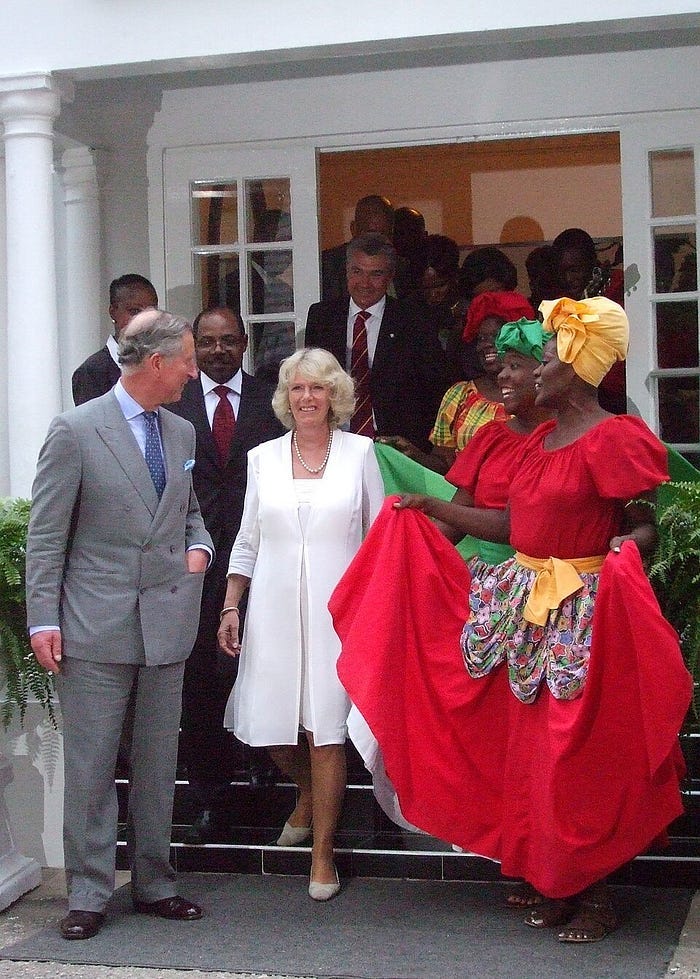
A delegation from Jamaica is visiting Britain, bringing with them a petition requesting that the following issues be addressed:
Whether the enslavement of Africans in Jamaica was legal under English law.
Whether it broke international law.
Whether Britain now has a legal duty to provide redress.
The hope was that Olivia Grange, Jamaica’s culture minister, would be able to hand King Charles the petition in person. The King, however, was away in Scotland on a previously arranged visit.
What Jamaica is seeking is reparations, an issue the King and Britain have danced around in recent years.
“We go fearless into another chapter in our story when we petition His Majesty King Charles on the matter of reparations. We anticipate that His Majesty will accept our petition and refer the questions to the Judicial Committee of the Privy Council. We are ready for those who will deny and oppose. To them I say, as we’ve been taught, let justice ring.”— Olivia Grange
Prince William and Princess Kate visited the Caribbean island in 2022, and its Prime Minister, Andrew Holness, told them there were “unresolved” issues and that the country was “moving on.”
A spokesperson from Buckingham Palace responded to the Jamaicans’ visit as follows:
“We understand the Jamaican government is seeking a petition to be heard before the Judicial Committee of the Privy Council. The process for seeking a petition is to lodge it with the Judicial Committee so that referral under section four of the 1833 Act can be considered. We also understand the Jamaican representatives will be received by the Foreign, Commonwealth and Development Office for bilateral discussions.”
He added: “His Majesty has on many occasions expressed his personal and wholehearted commitment to promoting greater understanding around the issue of slavery and finding ways to address historic wrongs for the benefit of communities today.
In America, one of the methods used to deflect requests for reparations is that the individual responding never enslaved people. Though often wrong. They believe they never personally benefited from enslavement. That case is a bit harder to make for King Charles, the Royal family, and Great Britain as a whole.
The British royal family’s wealth is best understood as two separate categories: (1) the monarchy’s institutional assets and (2) the monarch’s personal wealth. Based on the most recent reporting, the royal family’s total institutional wealth is estimated at $28 billion, while King Charles III’s personal net worth is roughly $750–800 million.
1. Total Royal Family Wealth (Institutional): $28 billion
This figure refers to the monarchy as an institution — not money the King can personally spend.
Major components
Crown Estate — $19 billion: A vast portfolio of land, commercial property, and seabed rights. Profits go to the UK Treasury; the King receives a portion back via the Sovereign Grant. Think of it like Jared Kushner managing billions for Saudi Arabia, Qatar, and the United Arab Emirates for a fee. The Sovereign Grant is taxpayer-funded support for official duties, palace maintenance, and staff, and has risen from £50 million (2012) to over £100 million (2025–26).
Duchy of Cornwall — $1.2 billion. Now held by Prince William.
Duchy of Lancaster — $850 million. A private estate generating income for the monarch.
Crown Jewels — $4–8 billion (non‑sellable). Held in trust for the nation; cannot be liquidated.
Royal Collection (art, artifacts) — priceless. Also held in trust, not personal property.
The personal wealth of the royals is in addition to the institutional wealth. Here’s a peek into their money.
King Charles III — $750–800 million (personal)
King Charles’s personal wealth comes from:
Private estates (Balmoral, Sandringham)
Personal investments
Inheritance from Queen Elizabeth II
His net worth increased after his accession, rising to $772 million.
Prince William — $40–50 million (personal)
Prince William’s personal wealth is separate from the Duchy of Cornwall (≈ $1.2 billion), which he controls but does not personally own. His private income from the Duchy was £6 million ($7.5M) in 2023.
Queen Camilla — $5–10 million (estimated)
Camilla’s personal wealth is modest compared to Charles’s, largely from inheritance and private property.
Prince Harry — $40 million (personal)
Harry’s wealth comes from:
Inheritance from Princess Diana
Military salary
Media deals (Netflix, books).
Princess Kate — $10–15 million (personal)
Kate’s personal wealth comes from her family’s business (Party Pieces), investments, and royal income.
Other senior royals (typical ranges)
These figures are less precisely documented but consistent with public reporting:
Princess Anne — $30 million
Prince Edward & Sophie — $10 million each
Prince Andrew — $5–10 million. Prince Andrew previously received a £250,000 annual allowance from the monarch. King Charles III terminated this in 2024, sharply reducing his guaranteed income.
Britain’s wealth, and the royal family’s place atop it, was built on slavery. For centuries, the Crown and its chartered companies trafficked human beings, worked them to death on plantations, and funneled the profits into the institutions that still sustain the monarchy—the Royal African Company, governed by kings, branded enslaved Africans like livestock. Crown‑held Caribbean estates ran on forced labor. And when Britain finally abolished slavery, the government paid slaveholders, including aristocratic families tied to the monarchy, while the enslaved received nothing. The royal family’s modern fortune may be wrapped in constitutional language and trust structures. Still, its foundations were poured with the wealth of an economy built on stolen labor, stolen lives, and stolen futures.
The Royals have indeed benefited from land seized from British subjects. From the Norman Conquest onward, the English (later British) Crown claimed ultimate ownership of all land in the realm. Under this system, kings routinely stripped land from subjects: nobles, clergy, and commoners alike, through legal and extralegal means:
Forfeiture and attainder: If a subject was accused of treason or fell out of political favor, the Crown could confiscate their estates. This happened repeatedly from the Middle Ages through the Tudor era.
Dissolution of the monasteries (1536–1541): Henry VIII seized millions of acres from the Church and redistributed them to loyal nobles, massively expanding royal and aristocratic land wealth.
Enclosure and eviction: Crown‑sanctioned enclosure laws displaced rural communities, converting common land into private estates controlled by the monarchy or its allies.
Colonial land grants: The Crown issued charters that seized Indigenous land abroad and granted it to royal favorites, embedding land theft into the empire’s economic structure.
Royal forests and hunting reserves: Royal decree declared large tracts “forest,” removing them from local use and placing them under Crown control. The very real Sherwood Forest you know from “Robin Hood” is an example.
By the 18th century, the monarchy had accumulated vast estates not because they purchased them on an open market, but because the Crown had the legal authority to take land and did so repeatedly. Many British families may well deserve reparations as well, but they should get in line behind Jamaica and other British colonies, past and present.
Many nations have sought reparations from Britain, and Britain has consistently refused, delayed, or reframed the demand.
Caribbean Nations (CARICOM) — The largest and most organized reparations demand
Countries: Jamaica, Barbados, Trinidad & Tobago, Guyana, Antigua & Barbuda, St. Lucia, Grenada, St. Vincent & the Grenadines, Dominica, Belize, Suriname, Haiti (observer).
What they sought:
Formal apology
Debt cancellation
Development programs
Health and education investment
Cultural and repatriation support
Direct compensation for slavery and genocide
How Britain handled it:
Refused reparations outright
Offered “dialogue” instead of compensation
Acknowledged “horrors of slavery” but rejected liability
No payments, no structural repair
This is the most important modern reparations movement directed at Britain.
Africa — Multiple nations, same pattern
Kenya — Mau Mau torture reparations
Outcome:
Britain paid £19.9 million to 5,228 survivors
Issued a formal apology
BUT refused to call it “reparations,” framing it as a “settlement”
This is one of the very few cases where Britain paid anything.
South Africa — Apartheid-era British complicity
Outcome:
Britain refused reparations
Supported symbolic truth‑and‑reconciliation efforts
No compensation
Nigeria — Colonial extraction and punitive expeditions
Outcome:
Britain refused
No apology, no compensation
Namibia — Herero & Nama genocide (Germany was the primary perpetrator, but Britain was complicit in colonial administration)
Outcome:
Britain refused reparations
No formal acknowledgment
Asia
India — Colonial extraction, famine deaths, and economic drain
Outcome:
Britain refused reparations
British officials argue “modern Britain cannot be held responsible”
No apology, no compensation
India’s economic losses under British rule are estimated at trillions, but Britain has never seriously engaged in reparations discussions.
Pakistan & Bangladesh — Partition violence and colonial extraction
Outcome:
Britain refused reparations
No formal apology
Middle East
Iraq — Colonial occupation and resource extraction
Outcome:
Britain refused
No compensation
Oceania
Australia — Aboriginal dispossession under British rule
Outcome:
Britain refused
Australia created domestic compensation schemes, but Britain has not participated
Europe
Ireland — Colonial rule, famine, land seizure
Outcome:
Britain refused reparations
No apology for the famine
No compensation
Ireland’s demands are less formalized than CARICOM’s, but the historical claim is well‑established.
The global pattern
Across continents, the response is identical:
Britain acknowledges historical harm but refuses reparations, reframes demands as “development,” or offers symbolic gestures instead of compensation.
The only meaningful payment Britain has ever made was to Mau Mau survivors, and even that was carefully framed to avoid setting a precedent.
Jamaica has been a member of the Commonwealth of Nations since gaining independence in 1962. Membership does not require recognizing the British monarch as head of state. Many Commonwealth countries are republics, but Jamaica remains a constitutional monarchy, with King Charles III as head of state. Jamaica has an active independence / republican movement. This movement is organized and government‑led, not fringe.
Key facts:
Jamaica’s government has repeatedly said it intends to remove the British monarch as head of state.
In 2022, the Jamaican Prime Minister publicly announced that Jamaica was “moving on” and would become a republic.
A constitutional reform committee was established to draft the transition.
The process requires:
Parliamentary approval
A national referendum
Public opinion polling shows majority support for becoming a republic.
Why the movement exists:
Colonial history and slavery
Desire for full political sovereignty
Reparations advocacy
A broader Caribbean trend (Barbados became a republic in 2021; Belize and Antigua & Barbuda are considering it)
Jamaica remains in the Commonwealth for now, but the country is actively working toward becoming a republic—a move driven by its history with Britain, its reparations demands, and a growing insistence on full sovereignty.
If Jamaica leaves the Commonwealth, Britain loses influence, legitimacy, and the illusion that its post‑colonial relationships are voluntary partnerships rather than historical residues. It’s not a financial loss, it’s a geopolitical and symbolic one, and that’s precisely why it matters.
Jamaica is one of the Caribbean’s most culturally influential nations and one of its most prominent former British colonies. If Jamaica leaves, it signals:
a rejection of Britain’s moral authority,
a rejection of the monarchy’s relevance,
and a public acknowledgment that the Commonwealth’s “family of nations” framing no longer persuades.
This is a reputational loss, not a monetary one — but reputational losses matter in diplomacy. Jamaica leaving would accelerate the regional trend toward republicanism and reduce Britain’s diplomatic footprint.
Britain may well ignore Jamaica’s request for reparations, just as it has ignored almost every other nation that has asked for reparations. That pattern is centuries old: acknowledge the harm, praise “shared history,” and then refuse compensation. But this time, the cost may be real. Jamaica is no longer asking from within the old imperial frame — it is preparing to step out of it entirely. If Britain refuses again, it risks losing not just moral credibility but Jamaica itself: its membership, its symbolic ties, its role in sustaining the Commonwealth’s shrinking relevance. And Jamaica stands to gain what Britain cannot offer: full constitutional independence, a republic built on its own terms, and the political freedom to pursue reparative justice without waiting for permission from a monarchy that has never granted it.
The Royal Slush Fund would be a good funding start. Nobody needs that much money except those that do. DD
The music was loud and lively at #1. Then it slowed to a sedate 2-step at #2. Then came to a nails on the chalkboard screeching stop at #3.
Whose going to blink first?😂